I like Google Buzz, since most of the postings that I can read there are mainly work related. It has also affected my blogging here: While I still don't seem to get many comments on my postings here, it seems people like to comment on Buzz, where this blog is listed as a connected site of my account. I will start adding links to Buzz threads of my blogs in the discussion section.
Converging the different Google technologies would be nice in this case. Google are also owning the site that is hosting this blog. Why can't Buzz threads related to this blog automatically appear here?
Wednesday, March 24, 2010

Thursday, March 18, 2010
Google Summer of Code 2010
Our (the Open Biology Foundation's) application for the Google Summer of Code has been accepted. http://socghop.appspot.com/gsoc/program/accepted_orgs/google/gsoc2010
I am offering to mentor a project to develop an All-Java Multiple Sequence Alignment algorithm as part of the BioJava project.
If you are an interested and skilled student, take a look at the project description, and if you think you are up for the challenge, send me an email with your application.
http://biojava.org/wiki/Google_Summer_of_Code
I am offering to mentor a project to develop an All-Java Multiple Sequence Alignment algorithm as part of the BioJava project.
If you are an interested and skilled student, take a look at the project description, and if you think you are up for the challenge, send me an email with your application.
http://biojava.org/wiki/Google_Summer_of_Code
Wednesday, March 3, 2010
Latest release of RCSB PDB web site contains all vs. all protein structure alignments
Last night we released the latest major version of the RCSB PDB web site. This release contains a number of exciting new features:
All vs. all protein structure alignments
* Interactive Structure Alignment Display
* Expert Mode for Protein Comparison Tool
General Site Improvements
* Home Page Layout and Customization
* OpenSearch Integration
* Resizable Viewer Applets
Query Results Page and Tabular Reports Improvements
* Bidirectional Sorting
* New Image Collage Page
* Report Table Filtering
* One-to-Many Relationships in Report Tables
Ligand Search Improvements
* Ligand Top-Bar Search
* Ligand Advanced Search
* Chemical Structure Search
* Ligand Summary Page
All vs. all protein structure alignments
* Interactive Structure Alignment Display
* Expert Mode for Protein Comparison Tool
General Site Improvements
* Home Page Layout and Customization
* OpenSearch Integration
* Resizable Viewer Applets
Query Results Page and Tabular Reports Improvements
* Bidirectional Sorting
* New Image Collage Page
* Report Table Filtering
* One-to-Many Relationships in Report Tables
Ligand Search Improvements
* Ligand Top-Bar Search
* Ligand Advanced Search
* Chemical Structure Search
* Ligand Summary Page
Friday, February 26, 2010
In our latest publication, we are discussing the benefits of the use of Widgets in bioinformatics and demonstrate a few examples that we are making available from the RCSB PDB website:
Will Widgets and Semantic Tagging Change Computational Biology?
Will Widgets and Semantic Tagging Change Computational Biology?
Tuesday, February 16, 2010
Testing upcoming release of all v.s. all protein structure alignment comparisons
At RCSB PDB we are currently working on an all vs. all comparison of PDB. A preliminary version of this is available from the betastaging site for public testing. e.g.:
http://betastaging.rcsb.org/pdb/explore/structureCluster.do?structureId=2W72
This is a beta site so it might not always be available or some things might not work as expected, still it should give you a pretty good impression of what is in preparation. If you want to help testing, have a look there and let me know how it goes.
Some documentation on the all vs. all procedure can be found here:
http://betastaging.rcsb.org/pdb/static.do?p=general_information/cluster/structureAll.jsp
http://betastaging.rcsb.org/pdb/explore/structureCluster.do?structureId=2W72
This is a beta site so it might not always be available or some things might not work as expected, still it should give you a pretty good impression of what is in preparation. If you want to help testing, have a look there and let me know how it goes.
Some documentation on the all vs. all procedure can be found here:
http://betastaging.rcsb.org/pdb/static.do?p=general_information/cluster/structureAll.jsp
Thursday, February 11, 2010
BioHackathon 2010
Currently the BioHackaton '2010 is happening in Japan. The goal is integration of biological resources with Semantic Web technologies. Brad Chapman is blogging about what is going on there. Here links to his blog:
Day 1
Day 2 - Python SPARQL query builder
Day 3 - Fish, interoperating and data retrieval
Day 4 - Improved python SPARQL query interface
Day 5 - The final day
Day 1
Day 2 - Python SPARQL query builder
Day 3 - Fish, interoperating and data retrieval
Day 4 - Improved python SPARQL query interface
Day 5 - The final day
Monday, January 25, 2010
How Informatics can help in a crisis
Today's blog is not about bioinformatics, but another open-source area in informatics that I feel passionate about: open geographical data. The OpenStreetMap (OSM) project provides free geographic data, such as street maps. It is essentially the wiki of the mapping world. In a response to the recent earthquake disaster in Haithi, OSM started the Project Haiti .
In short time so much data has been collected that what was before a largely empty map is now one of the most complete maps of Haiti. Michael Maron posted some before and after images on Flickr:
Before the earthquake (Jan 12th) :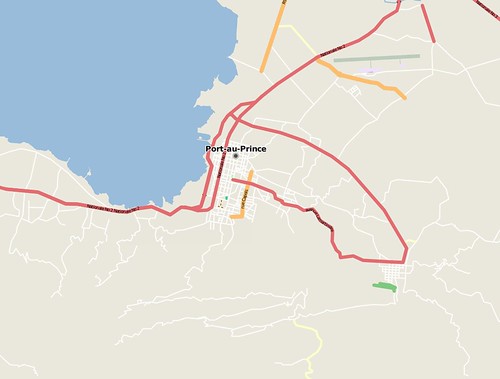
and by Jan 14th:
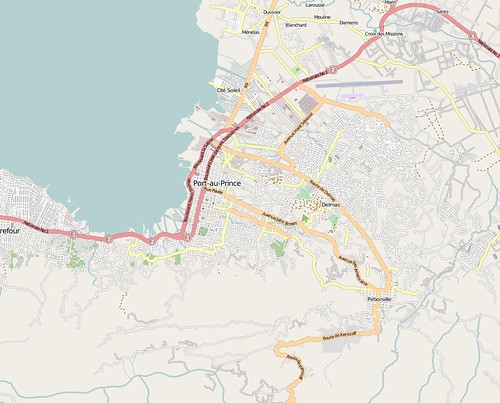
Beyond just marking roads, there is also an analysis of damaged buildings and displacement camps. This rendering, taken from the OSM wiki, shows damaged buildings and refugee camps mapped within OpenStreetMap.
A few other geographical projects related to Haiti are described at crisiscommons.org .
Resources:
In short time so much data has been collected that what was before a largely empty map is now one of the most complete maps of Haiti. Michael Maron posted some before and after images on Flickr:
Before the earthquake (Jan 12th) :
and by Jan 14th:
Beyond just marking roads, there is also an analysis of damaged buildings and displacement camps. This rendering, taken from the OSM wiki, shows damaged buildings and refugee camps mapped within OpenStreetMap.

A few other geographical projects related to Haiti are described at crisiscommons.org .
Resources:
- Project Haiti at OpenStreetMap
- Haiti Crisis Map shows the tagging of damaged buildings and camps, also can overlay sattelite images
Subscribe to:
Posts (Atom)