In our latest publication, we are discussing the benefits of the use of Widgets in bioinformatics and demonstrate a few examples that we are making available from the RCSB PDB website:
Will Widgets and Semantic Tagging Change Computational Biology?
Friday, February 26, 2010

Tuesday, February 16, 2010
Testing upcoming release of all v.s. all protein structure alignment comparisons
At RCSB PDB we are currently working on an all vs. all comparison of PDB. A preliminary version of this is available from the betastaging site for public testing. e.g.:
http://betastaging.rcsb.org/pdb/explore/structureCluster.do?structureId=2W72
This is a beta site so it might not always be available or some things might not work as expected, still it should give you a pretty good impression of what is in preparation. If you want to help testing, have a look there and let me know how it goes.
Some documentation on the all vs. all procedure can be found here:
http://betastaging.rcsb.org/pdb/static.do?p=general_information/cluster/structureAll.jsp
Thursday, February 11, 2010
BioHackathon 2010
Currently the BioHackaton '2010 is happening in Japan. The goal is integration of biological resources with Semantic Web technologies. Brad Chapman is blogging about what is going on there. Here links to his blog:
Day 1
Day 2 - Python SPARQL query builder
Day 3 - Fish, interoperating and data retrieval
Day 4 - Improved python SPARQL query interface
Day 5 - The final day
Day 1
Day 2 - Python SPARQL query builder
Day 3 - Fish, interoperating and data retrieval
Day 4 - Improved python SPARQL query interface
Day 5 - The final day
Monday, January 25, 2010
How Informatics can help in a crisis
Today's blog is not about bioinformatics, but another open-source area in informatics that I feel passionate about: open geographical data. The OpenStreetMap (OSM) project provides free geographic data, such as street maps. It is essentially the wiki of the mapping world. In a response to the recent earthquake disaster in Haithi, OSM started the Project Haiti .
In short time so much data has been collected that what was before a largely empty map is now one of the most complete maps of Haiti. Michael Maron posted some before and after images on Flickr:
Before the earthquake (Jan 12th) :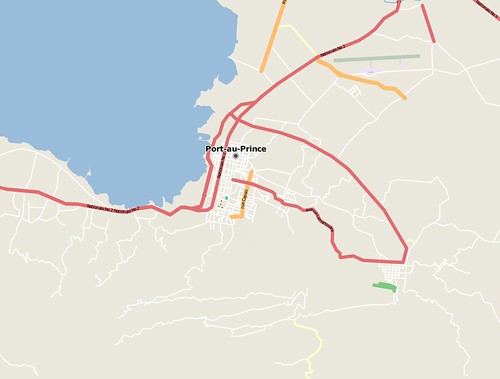
and by Jan 14th:
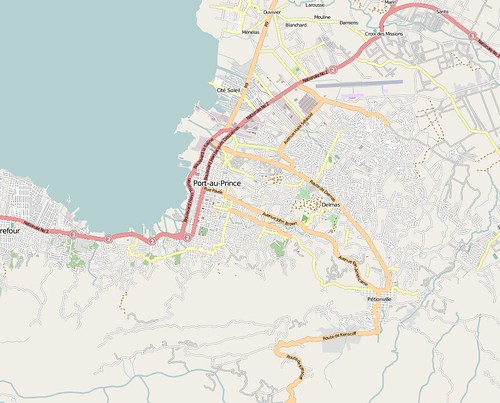
Beyond just marking roads, there is also an analysis of damaged buildings and displacement camps. This rendering, taken from the OSM wiki, shows damaged buildings and refugee camps mapped within OpenStreetMap.
A few other geographical projects related to Haiti are described at crisiscommons.org .
Resources:
In short time so much data has been collected that what was before a largely empty map is now one of the most complete maps of Haiti. Michael Maron posted some before and after images on Flickr:
Before the earthquake (Jan 12th) :
and by Jan 14th:
Beyond just marking roads, there is also an analysis of damaged buildings and displacement camps. This rendering, taken from the OSM wiki, shows damaged buildings and refugee camps mapped within OpenStreetMap.

A few other geographical projects related to Haiti are described at crisiscommons.org .
Resources:
- Project Haiti at OpenStreetMap
- Haiti Crisis Map shows the tagging of damaged buildings and camps, also can overlay sattelite images
Friday, January 22, 2010
BioJava Hackathon - Last Day
Today was the last day of the BioJava Hackathon. It has been an exciting week and we made progress along several lines, which I will talk about in a moment. Special thanks go to Jonathan Warren for organizing the meeting room at the Sanger Institute. Also thanks to our hackers without who this hackathon would not have been possible. In particular thanks to Scooter Willis, Jules Jacobsen, Andy Yates, Jonathan Warren, Christoph Gille, Matias Piipari for participating during the week and to our special guests who joined us for a day, Richard Holland and Jim Procter.
All the code that has been written is available through the new modules labeled with the biojava3 name. Most work was related to the new sequence and protein structure modules:
Sequence modules
There have been a lot of discussions about the current way sequences are represented over the last years. As such the "sequence guys" among the developers were working on coming up with a new design which is providing a biological meaningful (think central dogma) representation of sequences. What is still missing are file parsers using the new modules. The first fasta parser is about to be committed by Scooter as I am writing this. There is still more work required before the code will be ready for the next release. Still this is the beginning of a new data representation which should make the code base ready for the next couple of years.All the code that has been written is available through the new modules labeled with the biojava3 name. Most work was related to the new sequence and protein structure modules:
Sequence modules
Structure modules
The protein structure modules are the BioJava3-part which is closest to be released. During this week we have added the CE algorithm for protein structure alignment, implemented core interfaces for a generic Model View Control wrapping of various 3D visualization tools, we added better support for chemically modified residues (like MSE) and natural ones like Selenocysteine. They are treated now as amino acids. We also re-factored the code base to have the structure data model clearly separated from the new graphical user interfaces. This gui module now provides a nice way for calculating and visualizing protein structure alignments.
Next BioJava release (3.0)
There is still more work required to push the new sequence module to a state where it can be released. We also did not write any documentation this week, so that will have to be added later on. We will try to bring up the modules to a state where they can be released over the next weeks. Once a module is release ready a detailed summary of the new features will be posted to the mailing list. In any case there will be a BioJava 3.0 release in time for the ISMB/BOSC conference as we have been doing during the last years.
Thursday, January 21, 2010
BioJava Hackathon - Day 3
Today the various efforts of this week start to come together. We have several new or refactored modules in SVN that contain the code designed and written this week. They are named with biojava3 to clearly indicate that this are the new things.
BioJava Hackathon - Day 3 - Sequence Modules
Another main feature of the Wednesday session is an update to the sequence modules. Scooter Willis extended the sequence-core modules to provide the framework for working with sequences according to what was discussed earlier. There is still room for tweaks, refactoring and future optimizations but for the most part we can represent DNA,RNA and Protein sequences in a biologically aware manner with minimum code complexity at the top level. Check out the biojava3 package in the sequence-core module.
Subscribe to:
Posts (Atom)